Welcome To My Automotive Blog

August 16th, 2006

If you have come to this page through a search engine, it’s quite possible that the blog has changed since the spiders have come by and what you are searching for may be buried since I post quite often. Use the search box above to find what you need !

If this is your first time visiting AutoEducation.com make sure you check out the other sections in the site, we are much more than a blog.

AutoShop101 - Explains how all the major parts of your vehicle works, with sections on common problems and theory.

Car Care - If you ever wondered what was the best way to clean and care for your car, it’s in here. Washing, waxing and cleaning every part of your car is covered.

Road Machines - An excellent educational learning CD which is offered exclusively from AutoEducation.com This CD has interactive graphics and text which is easy to understand. We offer a free demo and we believe this is the best learning tool out there.

Online Repair Manuals - We offer online repair manuals from Alldata. You can subscribe and get your manual instantly. Besides excellent repair information, the Alldata manuals offer Recall information, Technical Service Bulletins and Labor Guides for most vehicles. Even if you don’t turn a wrench on your own car, AllData manuals are the best tool to make sure you are getting good service from your mechanic.

If you would like to ask an automotive question, feel free to give me a call via Skype


My status

1993 Asuna Sunfire Ignition Problems

April 20th, 2008

Question:

Hello Kevin,

I have a problem with starting my car, which is an asuna sunfire 93. And today I was supposed to check out what was wrong with it, but it was snowing outside. But I asked my dad what was wrong with it, and he said something about the ignition coil. What is that, and how can I repair it?

Sincerely,

Rameses


Answer:


Rameses,

The ignition coil creates high voltage for the spark plugs to fire the fuel and air mixture. Depending on your car, you may have one coil or multiple coils. When you have starting problems, you need to check the three major components your engine needs to run… air, fuel and spark.

Air: Check air filter and throttle body for any obstructions. Also check for loose electrical connections on the throttle position sensor.

Fuel: Make sure fuel filter is not clogged. On a fuel injected car, it’s harder to check for fuel flow since the fuel is at high pressure. I would check spark and if that’s good, then suspect low fuel flow as your problem.

Spark: You can pull a spark plug, reattach the spark plug wire and rest the tip of the spark plug on a metal part of the engine. Have someone crank over the engine and you watch the spark plug to see if you are getting a spark. Don’t touch the spark plug while you are turning over the engine, as you will get a shock if it’s working. They do make a tester for this, so you don’t have to take out the spark plug. You could also using a timing light if you have one to test for current to the plugs, but it will not tell you how strong the spark is. While you are there, take a look at the spark plugs themselves. Are they black and sooty or white. Black and sooty means rich mixture (too much fuel) white mean lean (not enough fuel)

As with working on any car, a good repair manual is invaluable to helping track down issues. The Alldata online manuals have troubleshooting procedures in the book, and is what the professional mechanics use to fix cars in their shops.

Good Luck,

Kevin


P.S. You may have to use Isuzu Impulse as your make and model for your repair manuals, since I am not sure Alldata lists the Asuna

P21S Car Wax Kit

April 4th, 2008

You have heard of P21S car care products in our car wax pages and hopefully you know by now it’s one of the best car waxes out there. The engineers at P21S have come up with a great product which I have used on my personal vehicles for years. I enjoy the shine and ease of application. The shine also lasts a long time, which means I don’t have to wax the car as much.

p21kit

I just wanted to let you know that P21S has a cool car care kit out there that gives you all the great P21S products you need to keep your car clean and shining like new.

You can buy it online at AutoGeek.net a great place for all your car care needs.

Subaru Head Gasket or Waterpump?

March 17th, 2008

Question:

Kevin

My Subaru builds up presure and blows the top pipe even with the radiator cap is of and it sounds like the water is boiling in the block i pulled the thermastat out tested it its ok then put it back in then i changed the radiator because i thought it mite be blocked but it still does it im pretty sure it ant the head gasket or cracked head that is the problem there is no water in the oil or oil in the water but i think as a resalt of it getting so hot. i think or hope it mite be the water pump what do u think

Answer:


With the engine warm, when you rev the engine, does the water level in the radiator go down? This would be an indication that the water pump is working if the level drops when you rev the engine. (don’t take the cap off when the coolant is hot to avoid getting burned, take it off before you start the car). This won’t tell you if the water pump is leaking though, and won’t tell you if it’s working at higher RPM’s. Sometimes the vanes on the pump will separate from the shaft and will keep the pump from pumping coolant at higher RPM’s.

It could be the head gasket or a cracked head even if there is no oil in the water or water in the oil. The head gasket can leak between the combustion chamber and the coolant passage and create excessive pressure in the cooling system. Also if the head is cracked in the combustion chamber area, as the intake charge is compressed, it will leak into the coolant passages and pressurize the cooling system. The only way to tell is to pressurize each combustion chamber one at a time and look for bubbles in the radiator. This should tell you which cylinder the leak is at. Most compression testers can be hooked to an air compressor to perform this test.


Good Luck,


Kevin

More things to think about when buying a new car…

March 7th, 2008

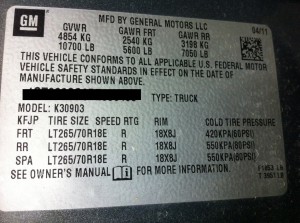
It just occured to me when shopping for new tires for my wife’s Envoy that there is more to think about when buying a new car than the upfront cost of the vehicle.

Like buying a copier or printer, it’s the consumables that end up saving or costing you money in the long run. Some manufacturers will actually almost give away printers to sell you overpriced ink cartridges for years to come.

On a vehicle your consumables are brakes, tires and filters. Let’s look at the tires today and the choices you can make at the dealership when picking out a new car.

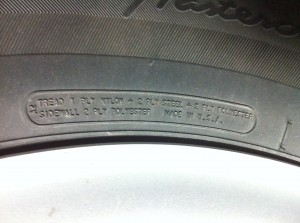
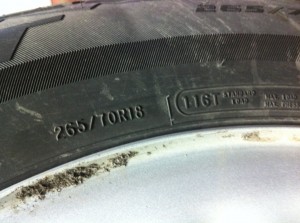
Tires: Probably the most expensive of the three consumables, tires will end up costing you $300 - $800 for a set of four depending on the size and type. High performance tires with a higher speed rating will cost more and so will larger diameter rim sizes. The popular trend is to have a lot of wheel showing and little tire sidewall. In the case of my wife’s Envoy GM put 17″ chrome wheels with 65 series tires on it. The cheapest tire available for my wife’s car was over $125 at my local tire store. A good set of Michelin’s were over $180 per tire. It’s a SUV, not a sports car, and a good 15″ tire would be fine. Checking tire prices at tirerack.com shows a $20 - $40 price difference between a 15″ and 17″ tire. So the next time you are at the dealer looking for a new car, consider the fact that those huge shiny wheels will cost a pretty penny when having to replace the tires mounted to them.


Kevin Schappell

What Octane to use in my car?

January 27th, 2008

Here is an email I recieved the other day from a cool car owner in Canada…

red gas pump

Hi, Kevin;

I came across your comments regarding octane while browsing the web for
fuel system info, and I disagree with you on this subject; your
contention that if the owners manual says ‘use 87′, then you suggest
that using premium fuel is ‘throwing money out the window’.

I used to feel that way, and could not find a definitive answer
anywhere (just opinions), so I set up a simple experiment back in 1987.
I bought a brand new car (Chevrolet Cavalier, Z24 model, with the 2.8L
V6 and a three-speed automatic transmission). This was a company car,
so my company paid for the fuel… and I ran it on nothing but Sunoco
94 Ultra, the highest octane fuel I could find in Canada; the manual
said to run it on regular, 87-grade unleaded gas.

Thousands and thousands of these cars were made and sold in north
america, so that was my base of comparison; when I finished the
experiment sixteen years, – and 330,000kms – later (when the car had
rusted away to the point of being unsafe), the following items were
still original, and unserviced..

The catalytic converter, the O2 sensor, the fuel pump, the fuel
injectors, the fuel rails, and the cylinder heads and valve-train.
Compression was still excellent on all cylinders. My dealer assured me
that at the ten-year mark (around 220,000kms) mine was the only ‘87
Cavalier that remained unserviced for fuel injector issues, and my car
was still flying through the bi-annual emissions test with great
numbers… right to its’ rusty end.

I put this down to several factors. One, Sunoco 94 can contain up to
10% ethanol (even back then!), and that I think aids in volatility and
with a fast ignition sequence. Second, Sunoco has a much more advanced
detergent-pac of additives in its’ premium fuel, and that eliminated
varnish from the injectors, pumps, and lines. Third, the greater heat
and faster flame-propagation of premium fuel eliminates (or greatly
reduces) carbon-build-up in the chamber and on the valves.

Was it a cost-effective experiment? I’d argue that it was, because the
cost of the catalytic converter alone exceeded the premium price I was
paying for gas (typically, 12¢ a litre more) annually. In fact, it
would have taken three to four years’ worth of my higher fuel costs to
equal the price of one converter… and the cost of having the
fuel-injectors serviced was about $800, and typically cars like mine
running on regular-grade needed this work every 100,000kms or so.

When I crunched all the numbers at the end of the experiment, it came
out as pretty much a wash (virtually even), but I completely escaped
the unpleasantness of unscheduled service visits due to vehicle failure
or poor emissions. That, and the fact that the car always ran great,
assured me that there was indeed a real value in burning nothing but
the best fuel available.

Now that I pay for my own fuel, I still use nothing but the very best,
highest octane… and that includes the diesel I put in my smart car,
too. And still, no run-ability issues with any of the family fleet.

So I think there actually is a difference, and a very real benefit…
but only after conducting that 16 year experiment!

Cheers, Malcolm (Canada)


And my response…


Malcolm,

I commend you on getting a cavalier to over 200,000 miles, it’s a testimate to your religious maintenance and care for the vehicle. I also thank you for taking the time to share your experiences with me. I have a few comments to add to the discussion…

1. I agree with your observations on better detergents in higher grades of fuel. I used to work at a Texaco station in High School and found better gas mileage using premium fuel over regular in my 1979 Ford Mustang. However since that time (late 80’s) the EPA has mandated higher detergent levels in all grades of gasoline. Texaco has since upped the detergent levels in their regular gasoline as have other brands. The major reason I got better mileage was probably because the engine had many miles on it and the carbon buildup in the combustion chamber mandated a higher octane rating.

2. A higher octane gasoline will actually burn slower ! This helps to prevent knock and also results in better combustion. It does not burn hotter, unless it’s in an engine with higher compression designed for a higher octane fuel.

3. For your experiment to really be valid, you would have had to have purchased an identical car and run regular fuel in it. I know this is being picky, but there could have been other factors effecting your outcome. The fact that you kept buying the same fuel is a big thing… by consistently buying fuel from a name-brand station, you assured a higher quality of fuel over the life of your vehicle. I always tell my visitors to be consistent in their purchase of fuel and even oil to keep their vehicles running their best.

4. My final comment to you and people reading my blog, would be to go with the lowest octane available that has a good level of detergents and meets the requirements set by your vehicles manufacturer. How can you tell which fuels have good detergent levels? Well the top tier gasoline program http://www.toptiergas.com/ is a good place to start. To be a top tier supplier, the gasoline companies must meet a stringent standard set my some of the top automobile manufacturers. This standard must be met by all grades of gasoline met, so it’s ok to run regular gasoline if your owners manual recommends it and you will still get the benefits of a higher detergent level.

One interesting note, if you look at http://www.toptiergas.com/ Sunoco Canada is on the list, but not the U.S. Company. This may be because of EPA regulations or tigher Canadian standards, which may or may not be part of the equation when looking at your experiment.

Take Care,

Kevin Schappell

Heater Controls Not Working

November 21st, 2007

Question: MY HEATER IS NOT WORKING.THERE IS NO HEAT COMING FROM THE FRONTS VENTS WHEN
I TURN THE SWITCH ON, IT ONLY BLOWS THROUGH THE TOP VENTS. WHAT CAN I DO?


Answer: The problem is probably behind the dash between the controls and the valve which controls where the air comes out. This is usually a cable on older vehicles, and an electric motor on some newer vehicles. I do not know for sure which style you have, but a quality repair manual will be able to give you diagrams and procedures for troubleshooting the system.

Fuel Injector cleaner in an empty tank.

November 21st, 2007

Question: What will happen if you put the fuel injection or carburator cleaner in a almost empty tank? Will the car still run ok?


Answer: Most cleaners are combustible, so putting a bottle in an empty tank should not cause any problems.

Diagnosing Drivetrain Noises

September 26th, 2007

Part of getting good service from your mechanic is accurate communication of noises and symptoms of the car trouble you are having. Here is a quick look at the most common drivetrain noises you may hear and the possible problems.


- Low frequency vibration when turning a corner usually points to a wheel bearing going bad. This usually sounds like a thump…thump…thump noise and varies with speed and how hard you are turning. To diagnose, your mechanic will raise your vehicle off the ground and check the amount of play in the wheel bearings. You can do this yourself with a jack in your driveway.


- High frequency clicking when making low speed sharp corners is a classic sign of a CV joint going bad. Front wheel drive vehicles use a constant velocity joint which can wear over time. If the boot which protects the joint from dust and keeps grease in, is damaged the wear can happen even quicker.

New Firebird Super Car…

September 7th, 2007

fire3314 Have you ever wanted to turn corners fast in your Trans-Am? Check out Highland Daytona’s G-Hawk. I work for the company making the rear suspension for the car, and can verify that it’s well built and makes this thunder chicken really handle !

This car will make Burt Reynolds blush when tearing up the track. The Smokey and the Bandit car has nothing on the G-Hawk.