 WAIT, BEFORE YOU SCROLL DOWN! While I know a lot about cars, I don't know a lot about YOUR CAR! A repair manual is essential and I have a way for you to get one FREE.
 Click Here To Read More(Link opens in a new window)
On The Road
Something Dragging?
It's common to have an exhaust pipe rust through and start dragging on the road after hitting a hole in the road or a bump. More to a safe area and inspect the exhaust system. It's never a good idea to drive a vehicle with a broken exhaust pipe, fumes can enter the passenger compartment and carbon monoxide poisoning can result. Wire can be used to tie up an exhaust system temporarily in the case of a broken exhaust hanger.
What's that buzzing sound?
Catalytic Converters and sometimes mufflers will have a heat shield attached to the top between the exhaust system and the car floor. This is to keep heat away from the passenger compartment. Overtime this shield may rust or become loose from the welds securing it, and start to vibrate. A muffler shop can usually reweld it and have you on your way. Mostly often times it's just annoying and will not present a safety issue, but better off safe than sorry. Get it checked!
The Exhaust System
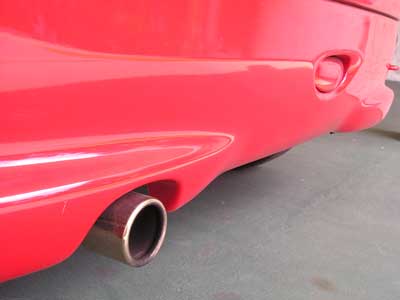
The automotive exhaust system.
Keeping your exhaust system in good working condition is vital for fuel mileage, the environment and your safety. We will discuss how the exhaust system works, how it usually fails, and the best way to repair it. Your car's exhaust system carries away the gases created when the fuel and air are burned in the combustion chamber. These gases are harmful to humans and our environment. Frequent checks of your exhaust system is a must to provide for you and your family's safety. Make sure there are no holes in the exhaust system or in the passenger compartment where exhaust fumes could enter. Let's begin by listing the parts of the exhaust system and their functions.
Exhaust manifold:
The exhaust manifold attaches to the cylinder head and takes each cylinders exhaust and combines it into one pipe. The manifold can be made of steel, aluminum, stainless steel, or more commonly cast iron.Oxygen sensor:
All modern fuel injected cars utilize an oxygen sensor to measure how much oxygen is present in the exhaust. From this the computer can add or subtract fuel to obtain the correct mixture for maximum fuel economy. The oxygen sensor is mounted in the exhaust manifold or close to it in the exhaust pipe.Catalytic converter:
This muffler like part converts harmful carbon monoxide and hydrocarbons to water vapor and carbon dioxide. Some converters also reduce harmful nitrogen oxides. The converter is mounted between the exhaust manifold and the muffler.Muffler:
The muffler serves to quiet the exhaust down to acceptable levels. Remember that the combustion process is a series of explosions that create allot of noise. Most mufflers use baffles to bounce the exhaust around dissipating the energy and quieting the noise. Some mufflers also use fiberglass packing which absorbs the sound energy as the gases flow through.Exhaust pipe:
Between all of the above mention parts is the exhaust pipe which carries the gas through it's journey out your tail pipe. Exhaust tubing is usually made of steel but can be stainless steel (which lasts longer due to it's corrosion resistance) or aluminized steel tubing. Aluminized steel has better corrosion resistance than plain steel but not better than stainless steel. It is however cheaper than stainless steel.Common Problems:
Well the worst enemy of your exhaust system is corrosion.... or more commonly known as rust. Rust is caused by moisture reacting with the iron in the steel and forming iron oxide. Moisture, or water vapor is present in the exhaust as a by-product of combustion and the catalytic converter. Moisture can also come from the outside in the form of rain. Short trips in your car can shorten the life of your exhaust system. When you shut down your engine whatever water vapor is in the pipes condenses and turns back into a liquid. On a short trip the water never has a chance to get hot enough to turn back into water vapor and just stays in the system and rusts away the pipes. If you drive for short distances consider replacing your exhaust system with stainless steel when the plain steel one rusts through. If you drive more than 15 miles at a time then you should not have to worry about this. If you live in an area which uses salt on the roads in the winter time, make sure to wash the underside of you car with water every few weeks. Salt speeds up the corrosion process and getting it off as soon as possible will help stop the corrosion. Make sure you run the engine after washing to drive off all of the water on the pipes.
Noticing a decrease in your gas mileage? Your oxygen sensor could be going south on you. As time goes on the oxygen sensor begins to wear out and becomes less accurate. This sometimes results in a rich fuel mixture where your engine burns more fuel than is needed. Most of the time your check engine light will come on and alert you to a failing oxygen sensor. I suggest changing the oxygen sensor every 60,000 miles just to be safe. Even though your check engine light might not be on, you could be using more gas than is needed. Pay a few bucks and change the sensor, your wallet will thank you when you have to buy less gas down the road.
The next part in line to go is the muffler. Most of the time mufflers rust through and need to be replaced. There are allot of options out there for replacement mufflers. Some cheap and some expensive. It holds true..... you get what you pay for. If you plan on keeping your car for any period of time, spend the extra cash and get an OEM muffler or a high quality name brand muffler.
On rare occasions the catalytic converter will become clogged and need to be replaced. Symptoms include loss of power, heat coming from the floor of your car, glowing red converter or a sulfur smell. Never let a mechanic tell you that you can do without the catalytic converter. Removing this component is illegal in most states and can lead to a hefty fine to the government if you are not careful.
That's about it for the exhaust system, just remember that rust is the biggest enemy to your exhaust system. Take the above mentioned steps and your exhaust system will last a long time.