 WAIT, BEFORE YOU SCROLL DOWN! While I know a lot about cars, I don't know a lot about YOUR CAR! A repair manual is essential and I have a way for you to get one FREE.
 Click Here To Read More(Link opens in a new window)
On The Road
Are your brakes making noise?
Light squealing is more than likely the brake pad indicators letting you know it's time to change your brake pads. Most pads will have a metal tab which is designed to contract the rotor when they are worn to a point of needing replacement. Change your brake pads as soon as possible. A grinding noise is more serious and usually indicated that the pads are worn to a point of metal-to-metal contact with the rotor. This is more serious as braking ability can be decreased since less brake pad material is contacting the rotor. Get service immediately if you hear grinding and expect to most likely have to replace your rotors as well.
Step on the brakes and it goes to the floor?
A bad master cylinder or low brake fluid due to a leak in the system are the most common causes. DO NOT DRIVE your car with no brakes. You will need to have the vehicle towed to the closest garage, or home to get repairs done. Rusty brake lines, blown brake hoses or even a bad caliper can cause your brake system to lose fluid and no longer stop your car.
Does it take a lot of effort to stop the car?
All modern cars have a vacuum booster which helps apply the brakes. If the diaphram in the boost goes bad, or the hose becomes disconnected pedal effort can rise and it will take more effort to stop your car. While possible to continue to drive your vehicle like this, it's not recommended as the effort required to stop the car is not something you will be used to, and panic stops may be compromised.
Want to be more prepared for roadside emergencies?
Video Clips
Automotive Brakes
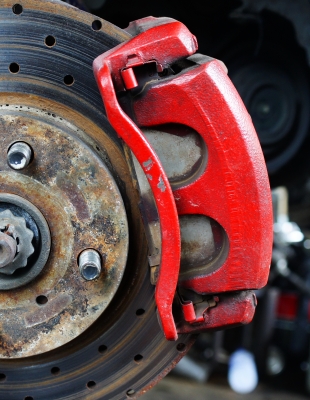
Learn how your car brakes work
Nothing stinks worse than having brake trouble and getting taken for a ride by your mechanic. Get the best information on brake repair so you do not get scammed at the garage. The braking system is a complex system which needs proper maintenance and care over the lifetime of your car.
Your car's brake system is a complex grouping of parts which serve a critical role in keeping you safe. No other system in the car is as important for your safety. Keeping your brake system in tip-top shape should be your top priority.
Let's start with the pedal and work our way down the braking system to better understand how it works. The Pedal is a strong steel lever which transmits the force from your foot to the master cylinder. The pedal typically has a switch attached to it, to turn on your brake lights when you press the pedal down.
When you push down on the pedal, the master cylinder is pushed via a push rod. The master cylinder consists of a piston and a fluid resevoir. When the piston is moved, it pushes the brake fluid through the brake lines and into the caliper or wheel cylinder.
Most all cars have disc brakes on the front wheels, and many have disc brakes on the rear also. When disc brakes are not used on the rear, drum brakes are used. The fluid being pushed from the master cylinder through the brake lines pushes a piston in the brake caliper. This in turn applies force to the brake pads.
The brake pads are typically made from a hard organic or metallic compound. The pads are made to survive under high heat and pressure. When the brake pads contact the rotor, there is friction and heat is created. This is how your car stops, by turning the rotating energy of your wheels into heat through friction.
The last part of your braking system is the rotors. Typically made from cast iron and made heavy enough to dissipate heat and not warp over time. Unfortunetly, in todays cars, many of the rotors are not large enough, and can warp within a few 1,000 miles. The rotor is bolted between the wheel and the spindle, and rotates at the same speed as the wheels.
Common problems:
-Wear: The braking system does a lot of work and the brake pads take the brunt of the punishment. It is a good idea to have you brake pads checked every 6 months or when you suspect a problem. Symptoms include squeaking, grinding, or increased stopping distance. Most pads have a thin metal tab which vibrates against the rotor when the pads wears down to a dangerous level. Some pads do not have this and if not checked periodically can wear down far enough to ruin the rotors. A modern trend is to make the brake pads very hard thus extending life. This harder material can squeak and sound like the wear indicators. Brake dust can also cause squealing but can be fixed by spraying brake cleaner on the brake system to remove the dust.
- Warped Rotors: More common in newer cars, but possible on all disc brake systems. Rotors warp due to being overheated or incorrect tightening of the wheel. A warped rotor will give a pulsing feeling when applying the brakes. This pulsing can be annoying and dangerous. Most newer cars have rotors which are very thin and warp very easy. Furthering the problem, the manufacturer does not leave enough material to resurface the rotor. Check with you mechanic to make sure you can safely have the rotors machined or replace with new rotors. To resurface, the rotor is placed in a lathe and a cutting tool removes a few thousandth's of material from the braking surface. This restores the flatness of the rotor and eliminates the pulsing sensation in the pedal. Make sure when your mechanic puts everything back together that he torques the lug nuts to proper specifications and never uses an impact wrench. If the lug nuts are not tightened evenly the rotor can warp and you are back to square one. Note: Some shops use a torque stick, which attaches to an impact wrench and does not allow the torque wrench to tighten more than it should. This is acceptable. If your mechanic does not use a torque wrench or torque sticks, find another mechanic.
Preventive Maintenance:
- Avoid "riding" your brakes. It's better to slow down with moderate pressure and then releasing the brake to cool, than riding the brakes and overheating them
- On steep grades consider downshifting to save your brakes. Only do this when traction conditions are good. In ice, snow, or even rain, downshifting into too low of a gear may cause a skid. Downshifting lets you engine do some of the braking instead of your brakes.
- Keep your wheels and braking system clean. Clean brakes work better and keep temperatures down. Use a good wheel cleaner which you know if safe for your wheel finish.
What to discuss with your mechanic:
- Be weary of low priced brake jobs advertised in the paper or TV. Some shops will try a bait and switch or find other parts which "need" to be replaced. Salesmen will try to make you feel guilty for putting your families safety on the line. They claim you need the premium pads and rotors, of course at a higher price.
- You mechanic should clean all the components of the brake system to ensure a dust and squeak free job.
- All bolts including lug nuts should have anti-seize compound on the threads to prevent them from rusting fast and causing headaches down the road.
- Have your mechanic use an anti-squeak compound on the back of the brake pads. This keeps the pads from vibrating and annoying you to no end. There are spray, and paste forms, with the paste working better for me.
- Insist on seeing the pads they removed from your car. There is no use paying to replace something that doesn't need to be replaced.
- National brake shops are not all bad. Some stores only do brakes so they should be pretty good at it. Ask around and get recommendations before you get work done. Quality depends on the owner of the national chain store, not the parent company so shop carefully.
- Do you need the lifetime brake pads? Well that depends on how long you will keep the car and how many rotors you plan on buying in the next few years. This initial cost is a little higher due to the fact the manufacturer knows he will most likely have to give you another set when yours wear out. Also these pads are made from a harder material and tend to wear down the rotors instead of themselves. You would be better off buying the basic pads and replacing them periodically instead of costly rotors every year or two.
- Make sure your mechanic uses a torque wrench or torque sticks on their impact guns. See above for the explanation.
Safety is important to you and your family. Stay safe by educating yourself and not by falling prey to the salesman. When you think you have a brake problem, take it to be checked by a mechanic you trust, for your families sake.
*Image courtesy of gameanna / FreeDigitalPhotos.net